
If you’re searching for practical, research-backed ways to support emotional development in kids, you’re in the right place. Modern parenting comes with endless advice—but not all of it is grounded in child psychology or real-life application. This article cuts through the noise to give you clear, actionable strategies that fit into your daily routines, not add to your overwhelm.
Parents today want more than surface-level tips. You want to understand why your child reacts the way they do, how to nurture resilience, and what actually helps build empathy, confidence, and emotional regulation over time. Here, we break down age-appropriate guidance, common challenges, and simple habits that strengthen connection and emotional awareness at home.
Our insights draw from established child development research and proven behavior strategies used by educators and pediatric specialists. By the end, you’ll have practical tools you can start using today to raise emotionally secure, self-aware children.
Why Your Child’s Emotional Toolkit Matters More Than Ever
Your toddler sobs because the blue cup is in the dishwasher. It feels small to you—but huge to them. That moment isn’t misbehavior; it’s skill-building in disguise. Modern parenting means guiding kids through big feelings in a loud, fast world. The goal isn’t stopping tears. It’s teaching tools.
Here’s the process:
- Name the feeling (“You’re frustrated.”)
- Normalize it (Feelings aren’t wrong.)
- Guide regulation (Breathing, choices, repair)
This is emotional development in kids—step by step. What’s next? Modeling calm yourself and practicing daily, not just during meltdowns. Ready to become their emotional coach?
Building the Bedrock: The Power of Safety and Connection
Before a child can talk about big feelings, they need to feel safe having them. Emotional growth doesn’t begin with discipline charts or long talks—it begins with security. In fact, decades of attachment research, beginning with John Bowlby’s work in the 1950s, show that children thrive when they experience consistent physical and emotional safety (Bowlby, 1969). Without that foundation, vulnerability feels risky instead of relieving.
This is where the idea of a secure base comes in. A secure base is a trusted caregiver who acts as both safe harbor and launchpad. A child ventures out—trying new skills, friendships, even tough conversations—knowing they can always return. Think of it like home base in tag (everyone runs back eventually).
So how do you build it? First, prioritize “special time.” Just 10–15 minutes a day of child-led, phone-free play can strengthen connection in a matter of weeks. Next, listen to understand, not just to respond. Reflect back what you hear before offering solutions. Finally, be consistent. Predictable responses to emotional needs reduce anxiety and support emotional development in kids over time.
Consistency today builds trust that can last for years.
Giving Emotions a Name: The First Step to Taming Them
Big feelings can overwhelm little bodies. Fortunately, neuroscience offers a practical tool: the “Name It to Tame It” principle. This concept suggests that when we label an emotion with words, we calm the brain’s alarm system (specifically, the amygdala) and activate the thinking part of the brain (Siegel & Bryson, 2012). In simple terms, words create space between feeling and reaction.
So what should you do? First, build a richer emotional vocabulary. Move beyond “happy” and “sad.” Introduce words like frustrated, disappointed, excited, and worried. A printed feelings chart on the fridge works wonders. Even better, narrate emotions in real time: “I see you’re feeling frustrated that the blocks keep falling.” Over time, this strengthens emotional development in kids.
However, some parents worry that talking about feelings encourages drama. In reality, the opposite is true. Children who can label emotions are less likely to explode because they feel understood.
Next, learn the difference between validation and agreement. Validation says, “It’s okay to feel angry.” It does not say, “It’s okay to hit.” Try this script: “I know you’re upset. I won’t let you hit. Let’s find another way.”
Finally, remember that movement also helps regulate emotions. Pair these strategies with insights from the importance of physical activity for growing children to support the whole child.
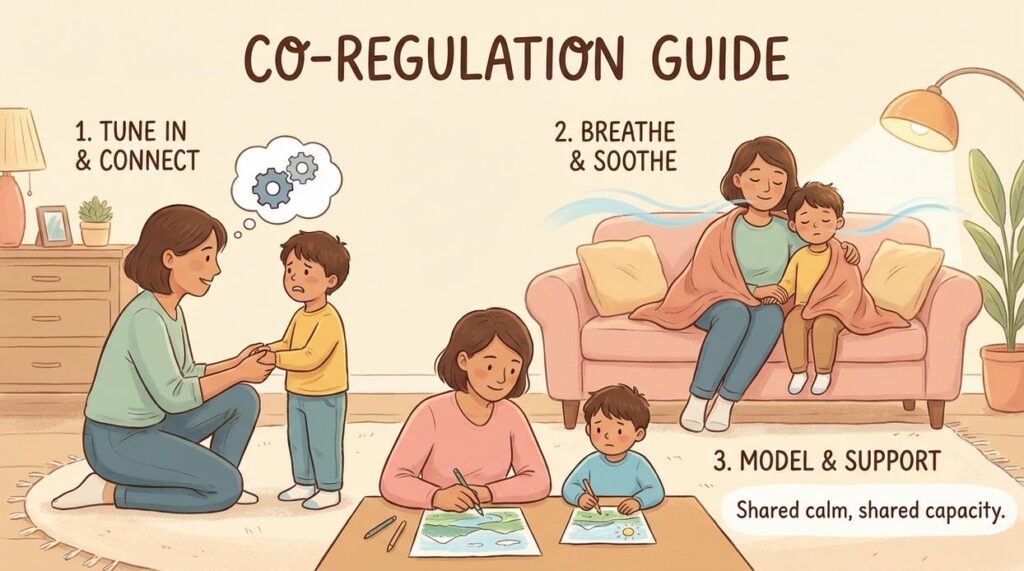
From Meltdowns to Management: A Parent’s Guide to Co-Regulation

When your child is mid-meltdown—tears streaming, voice booming, limbs flailing—it can feel like you’re standing in the eye of a tiny hurricane. This is where co-regulation comes in. Co-regulation is the process of lending your calm to your child when they are overwhelmed. In simple terms, you become their external regulator until they can steady themselves. Over time, this support strengthens emotional development in kids, helping them build self-regulation skills of their own.
Some argue children should “self-soothe” without parental intervention. While independence matters, neuroscience shows young brains rely on safe, steady adults to regulate stress responses (Center on the Developing Child, Harvard University). In other words, calm is contagious.
The Three-Step Co-Regulation Method
-
Stay Present & Calm
First, ground yourself. Take one slow breath in for four counts, out for four. Your non-anxious presence is the most powerful tool you have (yes, even more than that parenting book on your nightstand). -
See & Acknowledge
Next, get on their level. Gently narrate what you notice: “Your face is red, and your fists are tight. You look incredibly angry.” Naming emotions helps organize the brain (Dr. Daniel Siegel calls this “name it to tame it”). -
Soothe & Solve (Later)
Then, offer comfort if they’re open to it—a hug, a hand on the back. Importantly, wait to problem-solve until the storm passes.
As a practical tool, create a Calm-Down Corner. Add soft blankets, squishy toys, and a favorite book. Frame it as a safe reset space—not a timeout. (Pro tip: introduce it during a calm moment, not mid-eruption.)
Beyond ‘Me’: Cultivating Empathy and Lasting Resilience
When children can steady their own emotions, a powerful shift happens: they’re ready to look outward. Teaching empathy means helping them imagine life in someone else’s shoes (yes, even the sparkly ones). Try “I wonder” questions like, “I wonder how Sarah felt when you took her toy?” These gentle prompts build perspective-taking without shame.
Stories help too. Pause during books or shows and ask what a character might be thinking or feeling. This strengthens emotional development in kids and gives them language for real-life moments.
Resilience grows alongside empathy. Explain that challenges aren’t stop signs; they’re training grounds. Praise effort over outcomes: “You worked so hard on that puzzle!” This reinforces a growth mindset—the belief abilities improve with practice, a concept backed by psychologist Carol Dweck’s research (Stanford University).
The benefit? Friendships, problem-solving skills, and kids who bounce back instead of break down.
First, you created safety. Then, you built empathy. Step by step, you learned to pause, listen, and guide rather than react. As one mom shared, “When I stopped trying to fix everything and just said, ‘I’m here,’ everything changed.” That’s the heart of it.
Because your role isn’t perfection. It’s consistency.
- Show up calmly (even when it’s hard)
- Name feelings without judgment
- Model healthy repair after mistakes
Sure, some argue kids should “toughen up.” But research shows emotional development in kids thrives on responsive caregiving (Harvard Center on the Developing Child). So, in the long run, what could matter more than connection?
Give Your Child the Strong Start They Deserve
You came here looking for real, practical ways to support your child’s growth—and now you have them. From daily routines to mindful communication and connection-building habits, you’re better equipped to nurture emotional development in kids in ways that truly last.
Parenting can feel overwhelming. Big feelings, busy schedules, and constant second-guessing can leave you wondering if you’re doing enough. The truth is, small consistent actions make the biggest difference. When you intentionally support your child’s emotional world, you’re building resilience, confidence, and stronger family bonds.
Don’t let uncertainty hold you back. Start applying one strategy today—whether it’s creating a calm-down corner, practicing emotion coaching, or setting aside 10 minutes of undivided attention. Small steps lead to powerful change.
Thousands of modern moms rely on these proven, practical parenting insights to simplify routines and raise emotionally strong kids. Join them. Explore more tips, put these strategies into action, and start creating the calm, connected home your child deserves today.
 Founder & Chief Visionary